Which restaurant business loans are available?
Restaurants can use most kinds of business financing, but each fits a different job. The right one depends on whether you are buying equipment, building out a space, buying a restaurant or covering a slow month.
| Option | Fits | Watch for |
|---|---|---|
| SBA 7(a) loan | Buying a restaurant, buildout, equipment, working capital | Paperwork, weeks to close, unlimited personal guarantee from owners of 20% or more |
| SBA 504 loan | Buying the building or major equipment with 10+ years of useful life | Not for working capital or inventory |
| Term loan | Renovation, second location | Fixed payments in slow months too |
| Equipment financing | Ranges, refrigeration, dish machines | Built-in items are harder to finance |
| Line of credit | Food cost and payroll through slow weeks | Lenders may freeze it if sales drop |
| Merchant cash advance | Fast cash against card sales | High cost, daily or weekly debits |
Why do merchant cash advance funders target restaurants?
Because almost every ticket runs through a card terminal, a funder can see your exact daily sales in your processor statements and collect from them. A merchant cash advance is a purchase of a share of your future card sales or deposits, repaid through a holdback on each day's batch or through fixed daily or weekly debits. People often call it a loan, but it is structured as a sale of receivables.
That visibility is why restaurant owners get so many unsolicited offers. It is also why the product is expensive: the funder is buying sales from a business it considers risky.
Example: An advance of $50,000 at a factor rate of 1.35 means you repay $67,500. If daily debits clear it in about six months, the $17,500 cost works out to an annualized rate of roughly 125%.
If you do take one, ask whether the holdback is a true percentage of sales or a fixed debit, and how reconciliation works if sales fall. Avoid taking a second advance on top of the first (stacking). Run the numbers in the MCA calculator and read what a factor rate means before you sign.
How does seasonality affect restaurant financing?
It changes both how much you can get and which repayment structure is safe. A beach-town seafood spot may earn most of its year between Memorial Day and Labor Day. A campus burger bar loses its customers in summer. Many dining rooms soften in January after December's parties end.
Lenders and funders usually read 12 months of statements to find your slowest stretch, and some weigh the last three months heavily. Applying in your trough can shrink an advance offer. Fixed daily debits are hardest to carry when covers drop, so a line of credit you draw in slow months and pay down in peak season often fits a seasonal restaurant better.
What restaurant equipment holds value for financing?
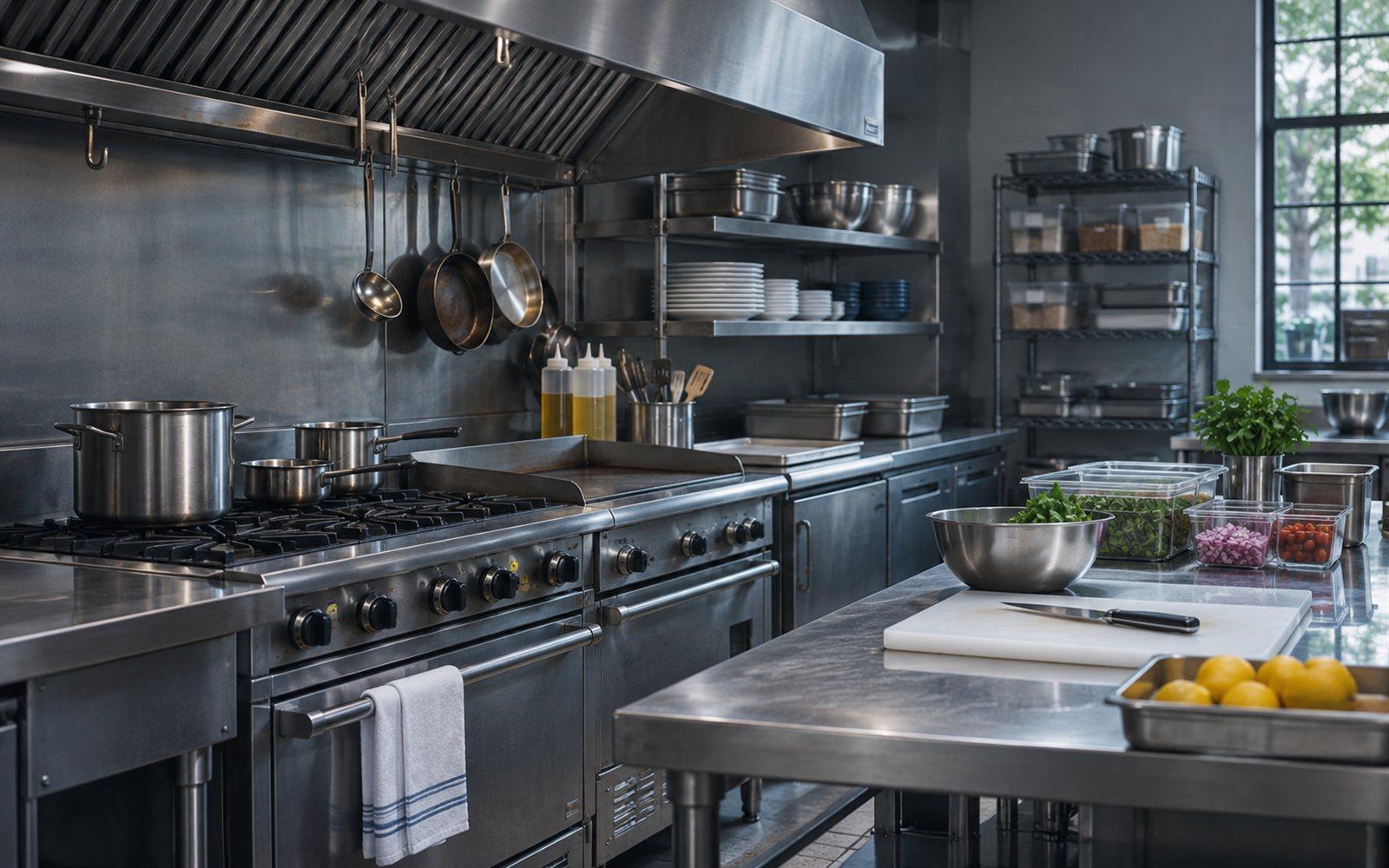
Standard, movable equipment holds value best: commercial ranges, fryers, combi ovens, reach-in refrigeration, ice machines and dish machines all have a used market. Lenders can repossess and resell them, so they lend against them more readily.
Walk-in coolers and hood systems are durable but installed. A hood with its fire suppression system is ducted through the roof, and a walk-in may be built into the space, so removing them is costly, and your lease may say they stay with the landlord. Expect lenders to treat them as part of a broader loan rather than as stand-alone collateral. Smallwares (pans, sheet trays, plates, glassware) have almost no resale value; pay for them from cash or working capital.
How do the lease and buildout affect a restaurant loan?
The lease decides how much of your project a lender can secure. Plumbing, gas lines, grease traps, electrical upgrades and finishes stay with the building, so they support little borrowing on their own. Many lenders want your lease, including renewal options, to run at least as long as the loan.
Negotiate a tenant improvement allowance before you borrow; every dollar the landlord puts into the buildout is a dollar you do not finance. Equipment lenders may also ask your landlord to sign a waiver letting them enter and remove financed equipment if you default. Read your lease for any landlord claim on your equipment before you pledge it elsewhere.
Example: A $180,000 remodel might put $70,000 of new cooking line on equipment financing and fund the remaining $110,000 of construction through a term loan or SBA 7(a) loan, after a landlord allowance.
How can a restaurant counter its high-risk reputation?
Restaurants have a reputation for closing early, and some providers will not fund them at all. You cannot change the category, but your records can show you are not the average file.
- POS reports for 12 to 24 months: daily sales, average check, covers and menu mix. Some funders ask for read-only access to POS or processor data.
- Processor statements that match bank deposits. Gaps between the two raise questions.
- Food and labor cost tracked monthly as a share of sales.
- Sales tax returns that match the revenue you report.
- Clean bank statements, with few overdrafts or returned payments.
Does a liquor license help a restaurant get financing?
It can help cash flow and, in some states, act as collateral. In states that cap the number of licenses, a license can carry real resale value. Florida, for example, limits certain liquor licenses to one per 7,500 residents of a county, and Florida law lets a lender hold a lien on a spirituous beverage license if it records it with the state within 90 days.
Rules on pledging licenses vary by state, so ask your state's alcohol regulator. Lenders want the license current and held by the operating entity. If you are buying a restaurant, the license transfer approval can set the closing date.
Do lenders treat franchise and independent restaurants differently?
Yes. A franchise comes with a franchise disclosure document, and lenders read Item 7 (estimated initial investment), Item 19 (financial performance representations, if the franchisor makes any) and Item 21 (the franchisor's financial statements). SBA lenders also check the SBA Franchise Directory when judging eligibility; a listing is not an endorsement. Royalties and marketing fees reduce the cash you have for debt payments.
An independent restaurant is judged on its own history and on your experience. Lenders want to see years of experience running a kitchen or front of house alongside the concept.
How do you apply through Kingsley Funding?
You can apply with Kingsley Funding; it takes a few minutes and Kingsley Funding does not run a credit check. We are not a lender. We share your application with lenders and funders that may be able to fund restaurants, and any provider you choose to move forward with may run its own credit check before making an offer.
Common questions
Can I get a loan to open my first restaurant?
It is the hardest restaurant file to fund. With no sales history, providers lean on your personal credit, the cash you are putting in, your experience running kitchens and a detailed budget for the buildout. SBA 7(a) lenders do fund startups, usually with an equity injection and a personal guarantee. Card-based advances are not an option until you have card sales.
Can I use an SBA loan to buy an existing restaurant?
Yes. SBA 7(a) loans can be used for a full or partial change of ownership, along with working capital, equipment and real estate, up to the $5 million program limit. The lender will want the seller's tax returns and sales records, and you will need to show you can run the place. Any liquor license transfer has to clear your state's approval process before closing.
Is a merchant cash advance a good idea for a restaurant?
Usually only for a short, specific need with a clear payback, such as replacing a failed walk-in compressor in peak season. Advances are fast, but they are among the most expensive ways to fund a restaurant, and daily or weekly debits bite hardest in slow months. If you qualify for a line of credit or SBA loan, those are almost always cheaper.
How do I finance a restaurant renovation?
Split the project by what each part is. New ranges, refrigeration and dish machines can go on equipment financing, where the equipment is the collateral. Plumbing, electrical, grease traps and finishes stay with the building, so they usually need a term loan, an SBA 7(a) loan or a tenant improvement allowance from your landlord. Financing smallwares over years rarely makes sense.
Can I finance used restaurant equipment?
Often, yes. Many equipment lenders finance used commercial equipment, usually with shorter terms than for new, and some want an invoice from a dealer rather than a private sale. Standard pieces with a resale market, such as ranges, fryers and reach-in refrigeration, are easier to finance used than custom or built-in items.
Sources
- U.S. Small Business Administration: 7(a) loans
- U.S. Small Business Administration: 504 loans
- U.S. Small Business Administration: SBA Form 148, Unconditional Guarantee
- U.S. Small Business Administration: SBA Franchise Directory
- 16 CFR 436.5: Franchise disclosure items (Cornell LII)
- Florida Statutes 561.20: Limitation on number of licenses
- Florida Statutes 561.65: Mortgagee's interest in alcoholic beverage license
Kingsley Funding is not a lender and does not make credit decisions. We connect business owners with lenders, funders and other business-financing providers. Submitting an application does not guarantee approval, and any rates, amounts or timing are set by the provider, not by Kingsley Funding.