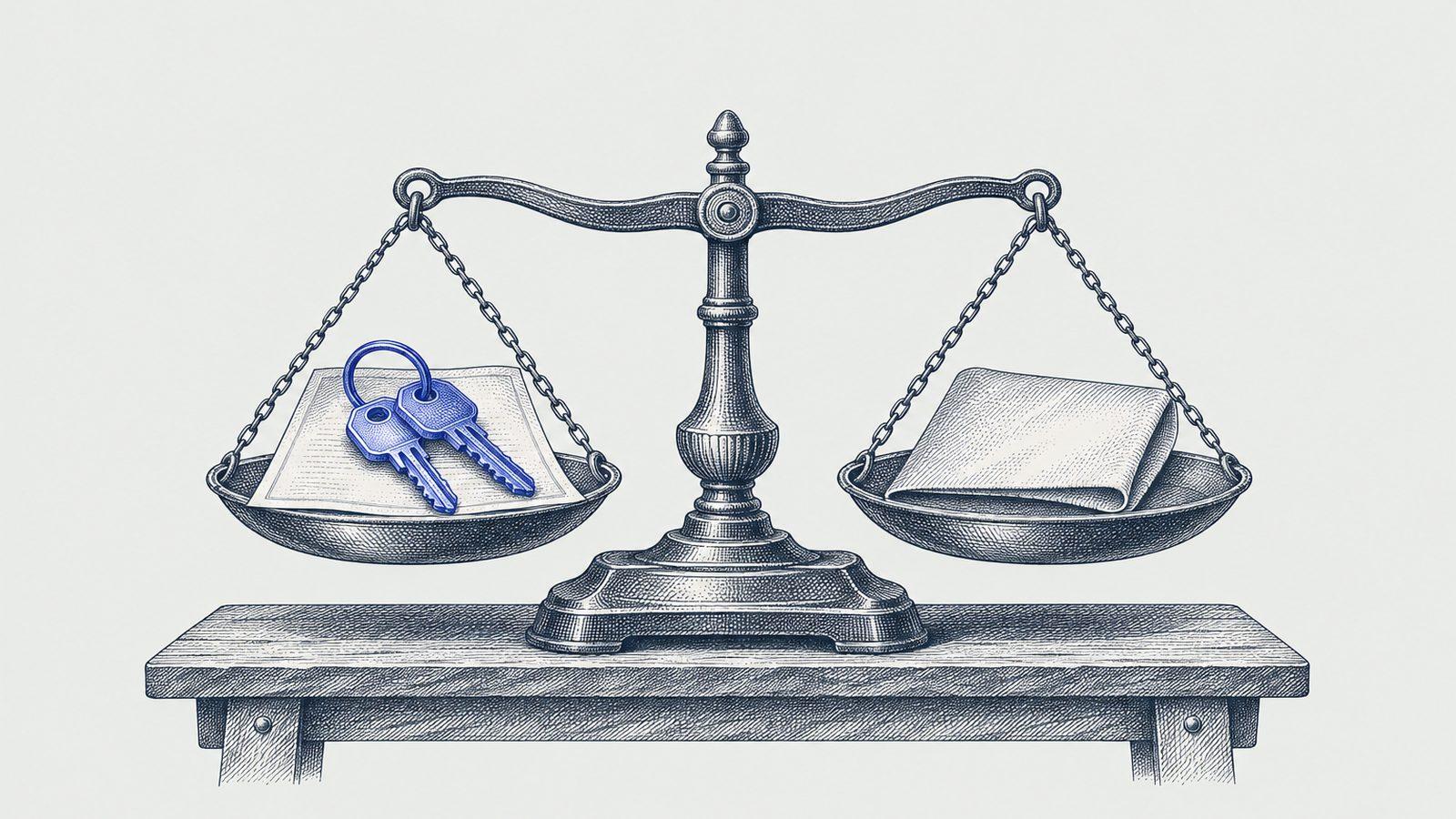
Take the loan if you will keep the equipment for years and it holds its value. Take a fair market value (FMV) lease if the equipment will be worn out, outdated or surplus before it is paid off. A $1 buyout lease sits in between and often costs more than a loan for the same machine.
The equipment financing page explains how each structure works. This guide puts numbers on the choice: what each one costs over five years, when the answer flips, and what to check in the contract before you sign.
What is the difference between an equipment loan and a lease?
With a loan you own the equipment from the start, and with a lease the provider owns it until you buy it. That one difference drives everything else.
| Equipment loan | $1 buyout lease | FMV lease | |
|---|---|---|---|
| Title during the term | You (provider holds a lien) | Provider | Provider |
| Cash at signing | Down payment, often 0% to 20% | Often first payment, sometimes first and last | Often first payment, sometimes a deposit |
| Payment size (typical) | Middle | Highest | Lowest |
| End of term | You own it | Buy it for $1 | Buy at FMV, renew or return |
| Who carries resale risk | You | You | Provider, unless you buy |
| Early exit | Pay off the balance | Usually all remaining payments | Usually all remaining payments |
Two points tend to surprise people. A lease payment is often due at the start of each month, while a loan payment is due at the end, so leases pull cash forward. And a lease quote rarely shows an interest rate, which makes it look cheaper than it is until you add up the payments.
How do you compare a loan and a lease over five years?
Add up every dollar you pay, then subtract what you own at the end. That is your net cost, and it is the only fair way to put a loan next to a lease.
Example: A sign shop needs an $85,000 large-format printer and expects it to be worth about $25,000 after five years. It gets three example quotes, all for 60 months:
Loan: $8,500 down, $76,500 financed at an example 8.5% APR. The payment is about $1,570 a month. Cash out over five years is about $102,671. The shop owns a $25,000 printer, so the net cost is about $77,671.
$1 buyout lease: No down payment, 60 payments of $1,795 due in advance, plus $1 at the end. Cash out is $107,701. Net of the $25,000 printer, the cost is $82,701. The payments imply a rate of roughly 10%, which the quote never states.
FMV lease: 60 payments of $1,495 due in advance, or $89,700. If the shop returns the printer, the net cost is $89,700. If it buys the printer for $25,000, it pays $114,700 in total and owns a $25,000 machine, so the net cost is still $89,700.
In this example the loan wins by about $5,000 over the $1 buyout lease and by about $12,000 over the FMV lease, because the printer keeps meaningful value. The FMV lease has the lowest payment and the highest net cost. You can run your own loan numbers in the business loan calculator.
The example ignores what the down payment could have earned elsewhere, taxes and any fees. Add documentation fees, required insurance and end-of-lease charges to each quote before you compare.
When does a lease cost less than a loan?
A lease wins when the equipment is worth little at the end of the term or when you only need it for part of its life. The resale value you expect is the number that flips the answer.
Example: Same three quotes, but the printer turns out to be worth only $8,000 after five years because newer models made it obsolete. The loan's net cost rises to about $94,671 and the $1 buyout lease's to $99,701. The FMV lease stays at $89,700, because the shop hands the printer back and the provider takes the loss.
That is the real job of an FMV lease: it moves the risk of a collapsing resale value to the provider. You pay for that protection through a higher total cost when the equipment holds up, and you come out ahead when it does not.
Short use works the same way. If you need a machine for three years out of a ten-year life, a loan leaves you selling a used machine and paying off a balance at the same time. A lease sized to three years avoids that.
What should you check at the end of a lease?
Read the end-of-term clauses before you sign, because that is where lease costs hide. The most common ones:
- Notice window. Many FMV leases require written notice of your choice 60 to 180 days before the last payment. Miss it and the lease may renew automatically, often month to month at the same payment.
- How fair market value is set. Some contracts let the provider set the value. Ask whether it is "in place" value (higher) or auction value (lower), and whether you can get an independent appraisal.
- Return condition and shipping. You usually pay to de-install, crate and ship the equipment to a location the provider picks, and you pay for wear beyond normal use.
- Fixed purchase options. Some leases set the buyout at a fixed share of the original cost, such as 10%. That is easier to plan around than FMV, and the payments sit between a $1 buyout and an FMV lease.
- Early buyout. Ask for the payoff formula in writing. Many leases charge all remaining payments.
Lease contracts vary a lot in these clauses, so on a large lease it is worth having a business attorney read the end-of-term and default sections before you sign.
How are loans and leases treated for taxes and on your books?
Generally, with a loan you own the equipment, so you depreciate it and deduct the interest. With a true lease the provider owns it, and you usually deduct the lease payments as a business expense instead. IRS Publication 946 notes that a lessee generally cannot depreciate leased property, because it does not keep the incidents of ownership.
The label on the contract does not settle it. A lease that works like a purchase, such as many $1 buyout leases, may be treated as a purchase for tax purposes, which can make it eligible for depreciation or the Section 179 deduction. Confirm how your specific contract will be treated with a tax professional before you choose on tax grounds.
The accounting is separate from the tax treatment. Under ASC 842, businesses that report under GAAP record most leases longer than 12 months on the balance sheet as a right-of-use asset and a lease liability. A lease no longer keeps the obligation off GAAP statements the way an operating lease once did, which matters if a lender or surety reads yours.
Should you lease or buy? A decision table
Use the row that best describes the equipment and how long you need it.
| Your situation | Usually fits best |
|---|---|
| You will use it most of its useful life, and it resells well | Loan |
| You want to own it but need the smallest cash outlay at signing | $1 buyout lease, or a loan with no down payment |
| It will be outdated in a few years (some technology, medical imaging, software-driven gear) | FMV lease |
| You need it for one contract or a few seasons | FMV lease, or rent |
| You are unsure about its value at the end | FMV lease, or a fixed purchase option lease |
| You need to keep payments as low as possible right now | FMV lease, knowing it may cost more overall |
| It is heavy equipment you would use only a few months a year | Compare renting with financing; see heavy equipment financing |
For work trucks and vans, the same logic applies, with a few vehicle-specific twists covered in business vehicle loans.
What should you ask for before signing either one?
Ask every provider for the same things so the quotes line up:
- The total of all payments, plus every fee, for the full term.
- The rate (APR on a loan, or the implied rate on a lease if they will give it).
- Whether payments are due in advance or in arrears.
- The down payment, deposit or advance payments due at signing.
- The end-of-term terms: buyout amount, notice window, return costs.
- The early payoff or early termination formula.
- What the UCC filing or lease covers: just this equipment, or more.
With those numbers you can build the net cost comparison above for your own deal in a few minutes.
How do you get equipment loan and lease quotes?
Get at least one loan quote and one lease quote for the same equipment, ideally before you agree to the dealer's financing. Kingsley Funding is not a lender. You can apply with Kingsley Funding; it takes a few minutes and Kingsley Funding does not run a credit check. We share your application with lenders and leasing companies that may fund your equipment, and any provider you move forward with may run its own credit check, sometimes a hard pull, before making an offer.
Common questions
Is it better to lease or buy equipment?
Buy, with cash or a loan, when you will use the equipment for most of its useful life and it keeps resale value. Lease with a fair market value option when the equipment goes out of date quickly or you only need it for a few years. A $1 buyout lease is close to a loan, so compare its total cost to a loan quote directly.
Is a $1 buyout lease the same as a loan?
Economically it is close: you make fixed payments and own the equipment for a dollar at the end. The paperwork differs. The provider holds title during the lease, the payment is often due in advance, and the rate may not be shown, so you have to work it out from the payments. For tax purposes it may be treated as a purchase, which your tax professional can confirm.
What happens at the end of a fair market value lease?
You usually choose to buy the equipment at its fair market value, renew the lease, or return it. Read how fair market value is set, whether you must give written notice months before the end, and what return condition and shipping costs apply. Some leases renew automatically month to month if you miss the notice window.
Do equipment leases show up on my balance sheet?
Under current US accounting standards (ASC 842), businesses that follow GAAP record most leases longer than 12 months on the balance sheet as an asset and a liability. Many small businesses keep tax-basis or cash-basis books instead. Ask your accountant how a lease will appear in the statements a lender or surety reads.
Can I end an equipment lease early?
Usually only by paying most or all of the remaining payments. Many equipment leases are written as noncancelable, so returning the equipment early does not end what you owe. If you think you may need out early, ask for the early buyout or termination terms in writing before you sign.
Sources
Written and fact-checked by Kingsley Funding Editorial. Read our editorial standards to see how guides are researched, checked and corrected.
Kingsley Funding is not a lender and does not make credit decisions. We connect business owners with lenders, funders and other business-financing providers. Submitting an application does not guarantee approval, and any rates, amounts or timing are set by the provider, not by Kingsley Funding.